

Scientists Develop Implant to Treat Eye Disease Threatening Military Marine Mammals
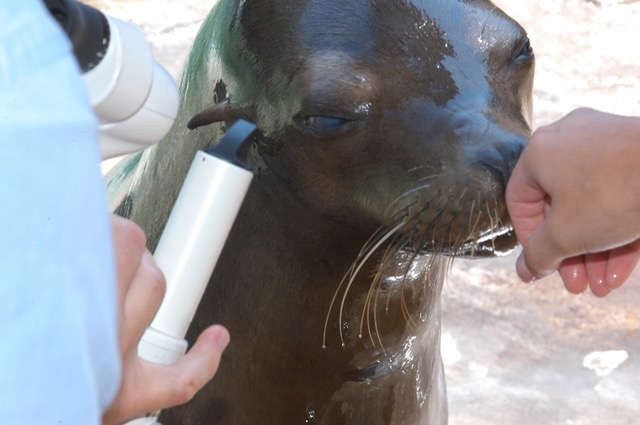
An unusual collaboration including veterinarians, marine mammal specialists and chemists is treating PCK, a group of eye diseases that affects the surface of the eye in marine mammals, with tiny ocular implants.
February 16, 2026 I By Dave DeFusco
California sea lions and bottlenose dolphins may seem like unlikely partners in national defense, but for decades they have played an important role in the U.S. Navy. Through the Navy Marine Mammal Program, these highly trained animals help locate and recover objects underwater, detect mines, support security operations and contribute to scientific research. Their work depends on sharp vision, comfort and trust with their human handlers. Yet many of these animals face a serious threat to their eyesight by a condition known as pinniped and cetacean keratopathy, or PCK.

Helping tackle that problem is an unusual collaboration that includes veterinarians, marine mammal specialists and chemists, like Brandie Ehrmann, director of the Mass Spectrometry Core Laboratory in the UNC Department of Chemistry, and Brian Gilger, a professor in the College of Veterinary Medicine at North Carolina State University and a leading expert in veterinary ophthalmology.
PCK is a group of eye diseases that affects the surface of the eye. It causes cloudiness of the cornea, open sores called ulcers and sometimes abscesses. Over time, these injuries scar the eye and can lead to partial or complete blindness. The disease is often painful, making it harder for animals to navigate their environment, perform trained tasks or simply live comfortably.
“This condition really only develops when these animals are managed by humans,” said Gilger. “They’re exposed to much higher levels of ultraviolet light than they would be in the wild, especially in very clean, clear water. That combination seems to trigger an autoimmune-type response in the eye, which is extremely challenging to treat.”
Several factors increase the risk of PCK. Light-colored or reflective pools bounce sunlight into the animals’ eyes. Lower water salinity, high UV levels, older age, past eye injuries and previous eye disease all play a role. Zoos and marine facilities have made changes, such as adding shade or mesh covers to reduce UV exposure, but these steps have not eliminated the problem.
Treating PCK is especially difficult because sea lions and dolphins live in water. Eye drops, which are commonly used to treat inflammation in humans, are quickly washed away once an animal returns to the pool. Administering drops multiple times a day also requires extensive training, time and personnel.
“For animals like dolphins, it’s basically impossible to keep them out of the water long enough for eye drops to work,” said Gilger. “Even with sea lions, it takes a lot of effort. A long-lasting treatment would completely change daily care for both the animals and the people who look after them.”
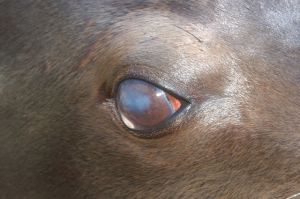
That long-lasting treatment may come in the form of tiny ocular implants. These implants slowly release an immunosuppressive drug, called tacrolimus, directly near the eye, reducing inflammation over months or even years. Similar implants already exist for humans and have been used experimentally in animals, but they are not designed for marine mammals. As a result, veterinarians often have to guess at dosing, use multiple implants and rely on surgical procedures that require anesthesia.
The goal of this new research is to design implants specifically for sea lions and dolphins that deliver the right amount of drug, last longer and are easier to place. Some versions may even be injectable, eliminating the need for surgery.
This is where Ehrmann’s specialty, mass spectrometry, becomes essential. Mass spectrometry is a highly sensitive chemical measurement technique that can detect extremely small amounts of a substance in complex samples like tears or tissue.
“At the most basic level, we’re answering a simple question,” said Ehrmann. “How much of the drug is actually getting to the eye and how long does it stay there?”
To find out, researchers collect small tear samples from animals after the implant is placed. Those tears contain trace amounts of tacrolimus released from the implant. Ehrmann’s team extracts the drug from the liquid and analyzes it using a highly sensitive instrument called a triple quadrupole mass spectrometer.

“This type of instrument is the gold standard when you need to measure very low concentrations,” she said. “It doesn’t just weigh the drug molecule. It breaks it into pieces and looks at a unique fingerprint. That’s how we know with confidence that we’re measuring tacrolimus and not something else.”
Working with marine samples presents extra challenges. Salt from seawater and natural compounds from tissue can interfere with measurements. Ehrmann’s team addresses this by carefully preparing samples to remove salts and by using specialized equipment that diverts unwanted material away from the instrument.
By analyzing tear samples collected over time, the researchers can build a curve showing how the drug is released and absorbed—a kind of timeline of exposure. That information is shared with the veterinary team, which compares it with eye exams and clinical scores.
“It’s very collaborative,” said Ehrmann. “They give us samples, we give them quantitative data, and together we figure out whether the implant is doing what it’s supposed to do.”
The impact of this work extends beyond animal welfare. For the Department of Defense, healthier marine mammals mean improved operational readiness and lower costs. A single implant that lasts years could replace daily treatments that demand significant staff time and resources.
“If we can keep these animals comfortable and visual with minimal intervention, that’s a huge win not just for the Navy, but for the animals themselves,” said Gilger. “The benefits, though, may reach even further. Similar eye diseases affect horses and humans, and advances made in marine mammals could one day inform treatments across species.”