

Samantha McDonald Awarded Prestigious Arnold O. Beckman Postdoctoral Fellowship in Chemical Sciences
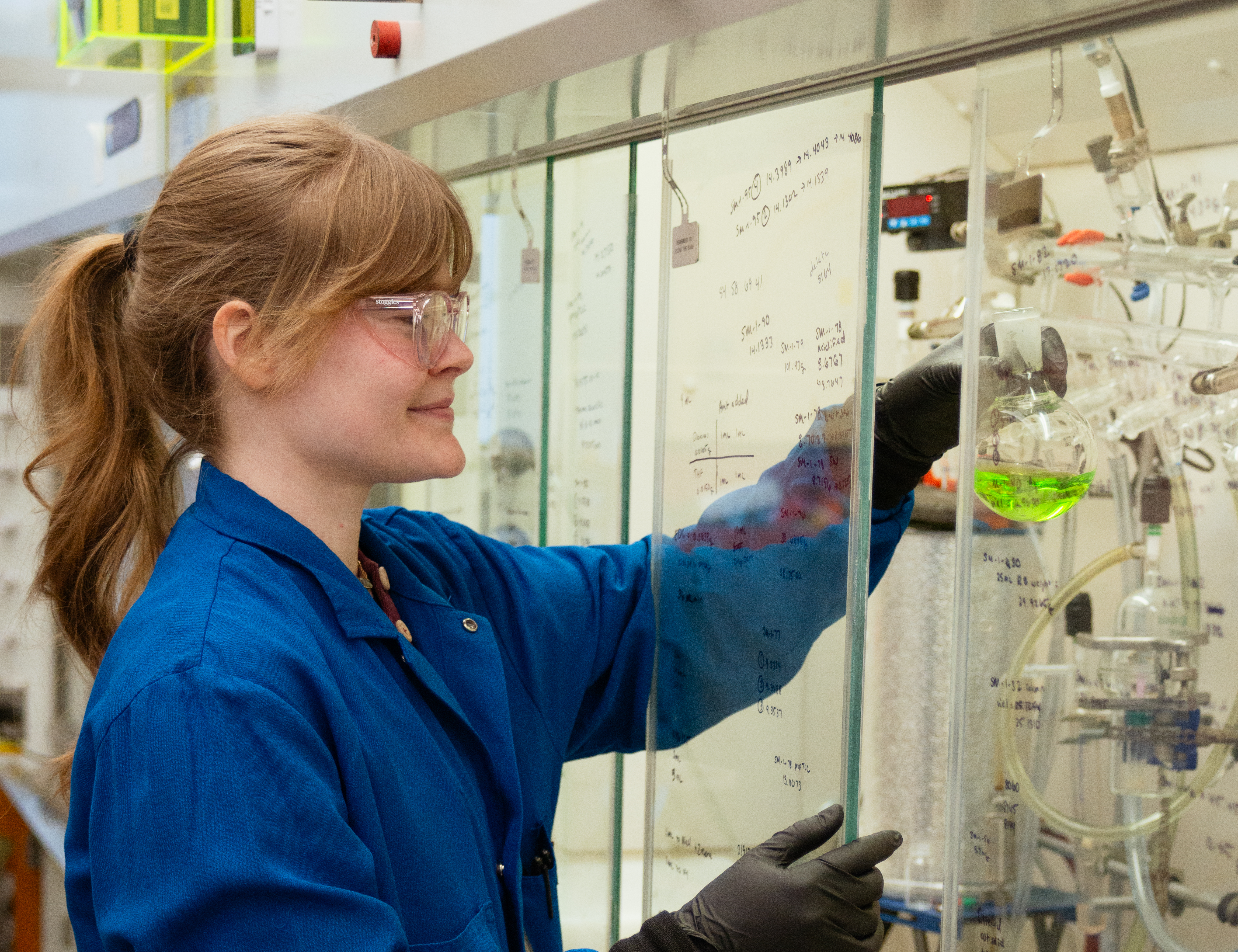
As an Arnold O. Beckman Postdoctoral Fellow, Samantha McDonald will focus on designing new materials that could help solve a growing challenge in modern technology: how to make electronics faster and more energy efficient.
April 2, 2026 I By Dave DeFusco
Samantha McDonald, a postdoctoral research associate in chemistry at UNC-Chapel Hill, has been awarded a 2026 Arnold O. Beckman Postdoctoral Fellowship in Chemical Sciences, one of the most prestigious awards for early-career scientists in chemistry who are opening new directions in research, from the Arnold and Mabel Beckman Foundation.
As an Arnold O. Beckman Postdoctoral Fellow, McDonald will focus on designing new materials that could help solve a growing challenge in modern technology: how to make electronics faster and more energy efficient.
“I feel incredibly honored. This is one of the most prestigious recognitions for a postdoc and I am incredibly grateful to the Arnold and Mabel Beckman Foundation for investing in our work,” said McDonald. “Professionally, it was very much a team effort. My advisor provided really helpful feedback. I think it also reflects the creative, intellectual atmosphere of our group that I was awarded this fellowship.”

McDonald conducts her research in the lab of Frank Leibfarth, Royce Murray Distinguished Term Professor of Chemistry, where scientists study advanced polymer materials, which are long chains of repeating molecules that can be engineered to perform specific tasks.
One focus of the lab is a developing field called spintronics, which could represent the next step in computing technology. Traditional electronics work by moving electrical charges through materials. Spintronics, however, also uses a property of electrons known as spin, a tiny magnetic orientation that can be manipulated to store and process information.
“Over the last decade, electronics performance has started to plateau with traditional approaches,” said McDonald. “As technology becomes more advanced, the demand for faster processing and lower energy use keeps increasing. Spintronics is promising because the spin property of electrons can be manipulated more easily than the flow of electrons, which could potentially increase processing speeds and reduce the power devices need.”
The challenge is that the materials currently used for spintronic devices are far from ideal. Many rely on heavy metals or heavily modified polymers, which can limit how well electron spins stay aligned, a key requirement for transporting information reliably. To address that problem, researchers in Leibfarth’s lab are exploring a new class of materials known as radical polymers. These materials contain special molecules with single, free electrons, which makes them good at carrying the magnetic signals used in spin-based electronics.
“Our goal is to design a new material that gets at the root of some of these challenges rather than trying to adapt existing materials that weren’t designed for this purpose,” said McDonald. “With this work, we’ll learn a lot about a new class of polymers that isn’t very well understood while also trying to address challenges in computing and electronics.”
At Carolina, the fellowship is seen as recognition of the university’s strong research environment. Diane Royle, senior director of foundation relations and industry engagement, supported McDonald’s application by coordinating the letter of intent, clarifying requirements and providing feedback on the proposal.
“This fellowship reflects the kind of innovative basic research happening across our campus,” said Royle. “We are deeply grateful to the Arnold and Mabel Beckman Foundation for its generosity and its commitment to supporting scientists who are pushing the boundaries of chemical discovery.”