

Fulbright Distinguished Scholar Award Fuels Breakthrough on How Proteins Behave Inside Cells
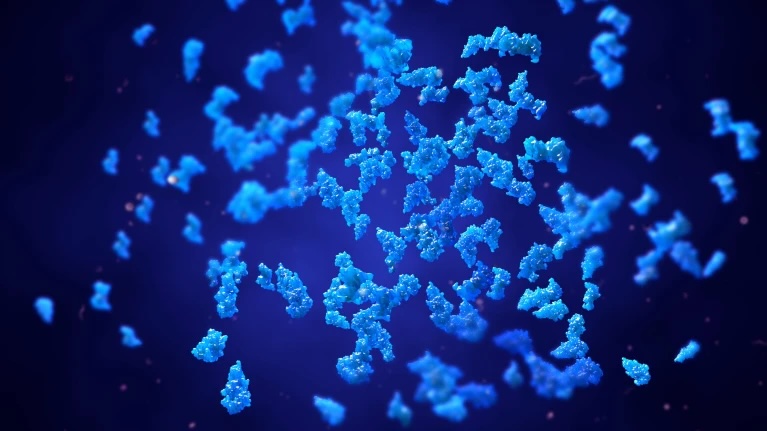
A computer-generated image of proteins. During Gary Pielak's residency in Jerusalem, he will immerse himself in the theoretical underpinnings of a model that he helped develop that tries to explain what happens to proteins in crowded environments. Credit: Design Cells/Getty Images
By Dave DeFusco
When Gary Pielak, Kenan Distinguished Professor of Chemistry, Biochemistry and Biophysics at UNC-Chapel Hill, began questioning the prevailing wisdom about how proteins behave inside cells three decades ago, he didn’t expect that line of inquiry would span the arc of his career. Now, that journey is entering a decisive new chapter. Pielak has received a Distinguished Scholar Fellowship from the Fulbright U.S. Scholar Program that will fund a four-month research residency in Israel, where he will pursue a fundamental question with far-reaching implications: How do proteins actually behave inside living cells?
For decades, scientists believed they knew the answer. Cells are densely packed—large molecules can exceed 300 grams in a space about the size of a quart—so the dominant view was that crowding stabilizes proteins by favoring compact, folded states. The logic was straightforward and rooted in entropy: In a crowded elevator, everyone pulls their arms in. Proteins, researchers assumed, do the same.
“But when we tested this idea,” said Pielak, “we found that it wasn’t always true. In fact, it was most often untrue.”
His lab began testing how stable proteins are not just in simple, watery solutions, but in environments packed with other molecules, or more like the inside of a real cell. At first, experiments using sugar molecules seemed to support the common belief that crowding helps proteins stay folded and stable.
When the team looked closely, however, they found something unexpected. Proteins weren’t being stabilized just because they had less room to spread out. Instead, the net effects were coming from actual chemical interactions between the proteins and the surrounding molecules.
The researchers tried using other proteins as the crowding molecules, which better reflects what happens inside cells. The results were even more surprising: proteins often became less stable in crowded conditions. When they measured protein behavior inside living cells, they saw the same thing. The foundational assumptions of macromolecular crowding theory were cracking.
“It’s easier to show a model is wrong than to build a new one,” said Pielak. “I didn’t want to be the guy who proved everything was incorrect and then stopped.”
Enter longtime collaborator, Daniel Harries, at the Hebrew University of Jerusalem. The two scientists first met at a Gibbs conference in 2004. Harries, who specializes in understanding how molecules behave and interact in liquids, had been developing new mathematical models. Instead of assuming that molecules only bump into each other and push each other away, his approach also included the idea that they can attract, stick to or otherwise chemically interact with one another. Over the years, through meetings in Germany, New Orleans, Telluride and Jerusalem, the collaboration deepened. Since 2022, their labs have co-authored five peer-reviewed papers.
The partnership works, said Pielak, because of communication and complementary strengths. “We’re blood-and-guts experimentalists,” he said of his lab. “We know how to make the difficult measurement. But when it comes to the deep waters of thermodynamics, Daniel is the guy.”
Together, the Pielak and Harries labs created a new way to explain what happens to proteins in crowded environments, similar to the inside of a cell. Their model considers two key ideas: first, that surrounding molecules can physically take up space and squeeze proteins, like people packed into an elevator and, second, that those surrounding molecules can also briefly stick to or interact chemically with the proteins.
What surprised them most was that the model includes just one adjustable parameter related to how thick the layer of solution is around a protein. Even though the model wasn’t designed using the usual rules that describe how large polymers behave, it still correctly predicted a well-known pattern seen in polymer science.
For Pielak and Harries, that was a major “aha” moment. It suggested their explanation wasn’t just fitting their own data, it was capturing something fundamentally true about how crowded systems behave. “The model wasn’t built using the usual rules scientists use to describe how large molecules behave,” he said. “But when we tested it, it still predicted those same patterns. That tells us we’re probably understanding the system correctly.”
Yet a key challenge remained. Much of the systematic data used to develop the model came from homopolymers, like polyethylene glycol. Real cells are crowded not by homopolymers, but by proteins.
Recent advances in AI-driven protein design—work recognized by the 2024 Nobel Prize in Chemistry awarded to David Baker—provided a solution. Designed protein families with similar surfaces and increasing molecular weights now allow Pielak’s lab to test whether the model holds under biologically realistic conditions. Preliminary data sent to Israel suggest that it does. Encouraged by those early results, the project is poised to move from theory and preliminary data toward broader biological impact.
Pielak’s work spans disciplines across campus. In addition to his primary appointment, Pielak is a member of UNC’s Integrative Program for Biological and Genome Sciences and the Lineberger Comprehensive Cancer Center, reflecting the broad reach of his research—from fundamental protein chemistry to questions central to cell biology and cancer.
The Fulbright Distinguished Scholar Fellowship arrives at a pivotal moment. During his residency in Jerusalem, Pielak will immerse himself in the theoretical underpinnings of the model while helping gather key measurements, such as how strongly solutions push or pull on water and how energy changes in the system, that are needed to fully test and finish the model.
“We’ve cracked the problem,” he said. “Now we can finish.”