

Study Shows Cooling Unlocks New Control of Sound Waves for Quantum Devices
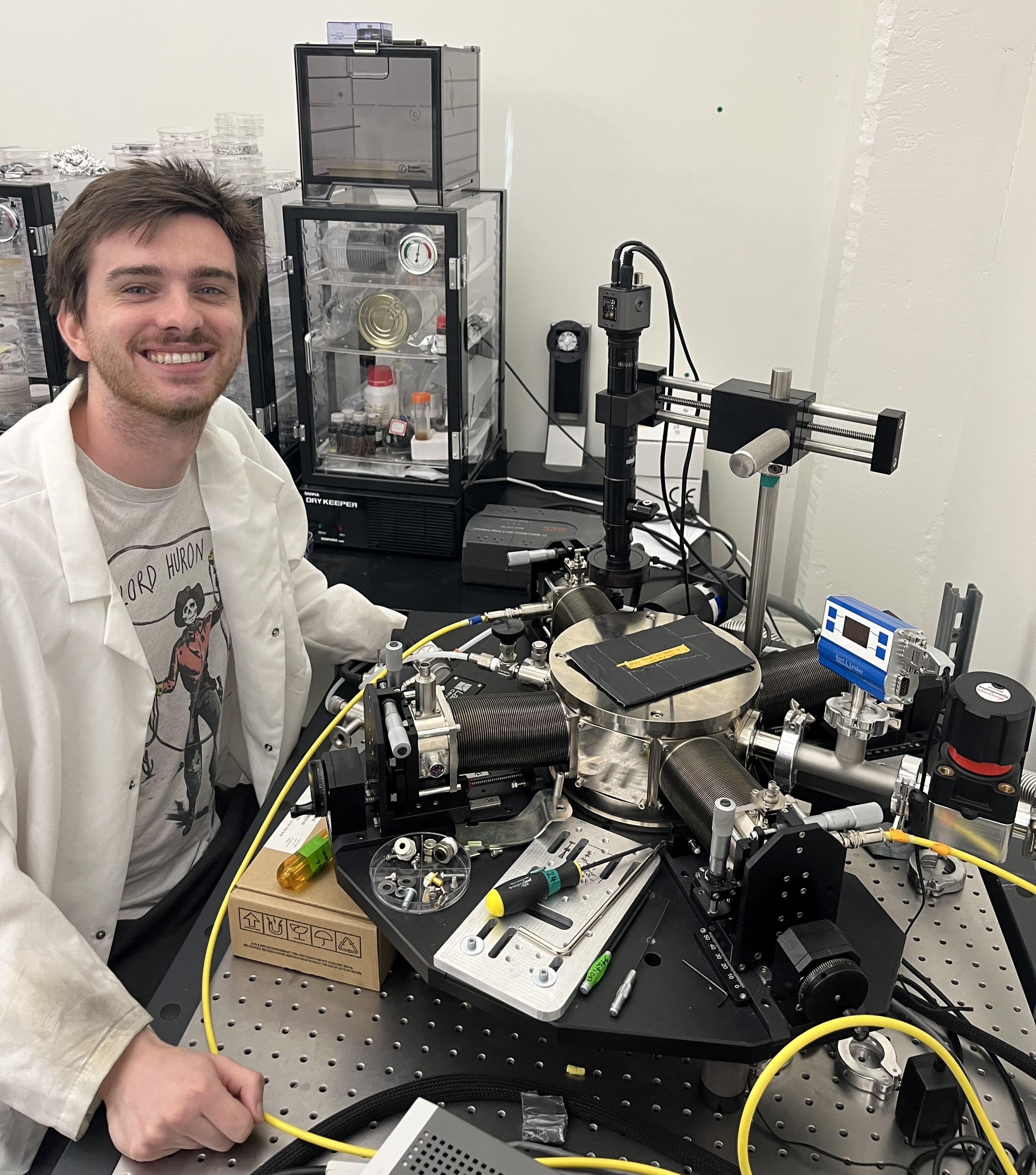
Chemistry Ph.D. student Andrew Christy at a probe station, a tool that lets researchers test very small electronic devices directly on a chip. In his work, the station is used to send signals into the device and measure how well those signals travel through it as the temperature changes and the material becomes superconducting.
April 15, 2026 I By David DeFusco
In a step toward smaller and more controllable quantum devices, researchers at UNC-Chapel Hill have found a new way to generate and control tiny sound waves using superconducting materials. Their study, published in APL Materials, shows that by cooling a material so it becomes superconducting, researchers can control how well surface acoustic wave devices transmit signals simply by changing the temperature.
The work, led by Andrew Christy, a Ph.D. student in the Department of Chemistry, was carried out in collaboration with NC State University, Argonne National Laboratory and University of Central Florida.
Surface acoustic waves, or SAWs, are vibrations that travel along the surface of a solid. Unlike light or other electromagnetic waves, they move much more slowly—about 3,000 meters per second. That slower speed allows scientists to shrink devices to much smaller sizes while still operating at useful frequencies. These compact devices can be built directly onto chips and are increasingly important in emerging quantum technologies.

“Because these waves move so slowly, you can pack a lot more functionality into a much smaller space,” said Christy. “That makes them really attractive for next-generation electronics and quantum systems.”
Traditionally, these devices have relied on metals like aluminum or gold to generate the waves, but those materials come with drawbacks, especially at the extremely low temperatures required for quantum computing. Gold never becomes superconducting, meaning it always loses some energy as heat. Aluminum can become superconducting, but it forms a thin oxide layer that can introduce noise and interfere with delicate quantum signals.
To overcome these limitations, the research team turned to a different material: niobium nitride. This compound becomes superconducting at relatively accessible low temperatures and avoids many of the issues seen in aluminum and gold. Christy said the research team initially chose the material simply to reduce energy loss, but they quickly discovered something more powerful.
“The most surprising thing was what I call the superconducting switch,” he said. “You can basically turn the device on and off with very small changes in temperature right around the superconducting transition.”
That switching behavior is at the heart of the study. As the material cools and becomes superconducting, its electrical resistance drops suddenly to zero. The researchers found that the transmission of the acoustic waves follows the same pattern. When resistance is high, the waves barely travel. When resistance disappears, the signal becomes much stronger.
“We saw about a 16 times difference between the on and off states,” said Christy. “That’s because in the normal state, the material resists the flow of current, so you don’t generate much of a wave. Once it becomes superconducting, however, there’s no barrier anymore, and the transmission jumps dramatically.”
This approach offers a new way to control these devices. In most cases, engineers rely on voltage or physical design to determine how a device behaves, but those factors are often fixed once the device is built. Temperature, on the other hand, provides a new level of flexibility.
“With traditional designs, the geometry is set. You can’t really change it after fabrication,” said Christy. “Here, you can keep the same electrical signal and just tune the device using temperature. It gives you another knob to control how it works.”
The team also found that using niobium nitride improved the clarity of the signal. In many devices, internal reflections can distort the output and make it harder to predict performance. The new design reduces those reflections, leading to cleaner and more accurate behavior.
Wei Zhang, an associate professor in UNC’s Department of Physics and Astronomy and a senior author of the study, said the findings could help advance quantum technologies that rely on precise control of signals.
“This work shows another useful way to modulate acoustic waves using superconductivity,” he said. “It opens a path toward integrating these devices directly into quantum systems with improved efficiency and control.”
Beyond physics, the research highlights the importance of collaboration across disciplines. James Cahoon, chair of UNC’s Department of Chemistry, praised Christy’s role in pushing the work forward.
“Andrew brought together materials science, physics and device engineering in a very thoughtful way,” said Cahoon. “His work demonstrates how careful design at the nanoscale combined with deep understanding of the underlying physics and materials can lead to new concepts and understanding relevant to quantum devices.”