

Graduate Students to Lead Symposium at National Conference on Chronic Lab Toxicity
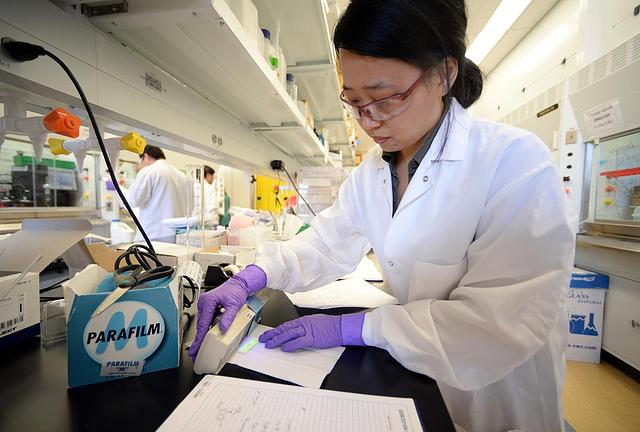
The symposium’s goal is threefold: to disseminate practical knowledge about chronic toxicity, highlight effective training approaches and foster informed discussions about minimizing long-term exposure in research settings.
March 9, 2026 I By Dave DeFusco
At a conference celebrated for scientific breakthroughs, graduate students from UNC-Chapel Hill are turning the spotlight onto the hidden, cumulative risks faced by the scientists themselves. On March 25, 2026, at the American Chemical Society Spring Conference in Atlanta, the UNC Joint Safety Team will lead a daylong symposium, “Chronic Toxicity in the Lab,” challenging the chemistry community to confront a quieter danger: the slow, often overlooked exposures that can shape careers, health and lives long after the experiments end.
The symposium is organized by five members of Carolina’s Joint Safety Team: Rebecca “Becca” Powers and James Sappington of the Dempsey Lab; Kyra Tripp of the Waters Lab; Devon Leimkuhl of the Jackson Lab; and Leah Kosovsky of the Zhukhovitskiy Lab. The student organizers were mentored by Amanda Chung, chemical hygiene officer and manager in Carolina’s Environment, Health and Safety office, who guided the group as they developed the symposium and helped connect their ideas with broader safety efforts across the chemistry community.
Their event is co-sponsored by the ACS Committee on Chemical Safety and the ACS Division of Toxicology, and will feature 12 speakers from across academia, industry and government.

For Powers, a Ph.D. student in the Department of Chemistry, the idea grew from a gap she and her colleagues noticed in safety conversations.
“Chemists are generally well trained to respond to acute hazards like fires or spills,” said Powers, “but chronic, low-level exposure is different. It’s quieter. It happens over months or years, and it requires a much more intentional understanding. We wanted to create a space where people could really dig into that.”
The symposium’s goal is threefold: to disseminate practical knowledge about chronic toxicity, highlight effective training approaches and foster informed discussions about minimizing long-term exposure in research settings. The organizers were especially interested in exploring how academic and industrial laboratories differ in preparing researchers to recognize and manage cumulative risks.
“We envisioned this as a forum where graduate students, faculty and safety professionals could all learn from each other,” said Powers. “By bringing those perspectives together, we hope to spark conversations that continue long after the conference ends.”
The morning session will begin with Amanda Pitt, a Ph.D. student at the University of Connecticut and president of her institution’s Joint Safety Team. Her talk focuses on building a culture of safety through interactive workshops for first-year graduate students, emphasizing proactive education rather than reactive compliance.
Entrepreneur Neelam Vaidya will discuss digital tools for authoring safety data sheets and predicting hazards in chemical mixtures, helping laboratories maintain up-to-date information and safer inventories. Penny Antoniou of Ansell will address cumulative permeation in personal protective equipment—how small amounts of chemicals can pass through gloves over time and what that means for long-term exposure.
Kate McKnelly of Emory University will share a retrospective analysis of exposure to peptide coupling agents in academic labs, offering a personal and professional perspective on sensitization. Daniel Scungio and Jason Nagy of Sentara Health will examine how chronically poor lab safety practices can create lasting consequences and how inadequate training compounds risks over time.
A panel discussion late in the morning will allow attendees to ask questions and compare experiences across institutions.
The afternoon session shifts toward research and policy. Diana Garnica Acevedo of George Washington University will present computational models that predict bioavailability and biodegradation of small molecules, tools that can help anticipate long-term environmental and human health effects. Paul Schlosser, formerly of the U.S. Environmental Protection Agency, will provide an overview of health risks from cumulative chemical exposure, drawing on decades of work in pharmacokinetic modeling.
Ekin Atilla-Gokcumen will discuss how chronic exposure to PFAS can trigger oxidative stress and alter lipid levels in cells. Greg Moss and Stuart Feinberg of Argonne National Laboratory will describe how risk-based chemical safety programs and exposure assessments can reduce hazards through improved ventilation and engineering controls. The day concludes with Melanie Flint, who studies how chronic stress affects genetic pathways and cancer biology, underscoring that toxicity can extend beyond chemicals alone.
For the Carolina graduate student organizers, the symposium represents more than a single event. It reflects a broader commitment to redefining safety as an integral part of scientific excellence.
“Health and safety aren’t separate from good lab practice; they’re foundational to it,” said Powers. “If we want sustainable, innovative science, we have to make sure the people doing that science are protected, not just today but years down the line.”