

In New Textbook, Andrey Dobrynin Simplifies the Science Behind Everyday Materials

For the past 30 years, Andrey Dobrynin, Mackenzie Family Distinguished Professor of Chemistry at UNC-Chapel Hill, has taught polymer science. His new textbook explains how polymers behave and why that behavior matters in real life, covering both classical topics—the basic concepts every scientist needs—and contemporary topics emerging from current research or challenges arising in industrial laboratories.
March 8, 2026 I By Dave DeFusco
Most of us interact with polymers every day without even realizing it. The plastic handle on a coffee mug, the rubber sole of a shoe, the soft gel in a contact lens are all polymers: long, flexible molecular chains that behave in surprising and useful ways. Even the DNA inside our cells is a polymer—nature’s own double-twisted chain of life.
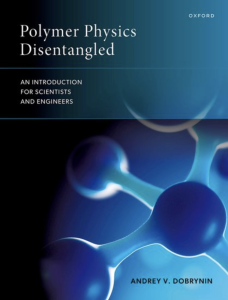
Until now, polymer science has often felt intimidating to students and engineers who don’t live and breathe chemistry. That’s the gap Andrey Dobrynin, Mackenzie Family Distinguished Professor of Chemistry at UNC-Chapel Hill, set out to fill with his new textbook Polymer Physics Disentangled: An Introduction for Scientists and Engineers.
Dobrynin has taught polymer science for more than 30 years. He has seen students struggle with advanced mathematics, sporadic explanations and textbooks that assume more background than many readers possess.
“I wrote this book because students deserve something clear and unified,” he said. “They shouldn’t open a page and be confused by different notations or buried concepts. It should feel like one voice guiding you through the subject.”
At its heart, the textbook explains how polymers behave and why that behavior matters in real life. To achieve this, it covers both classical topics—the basic concepts every scientist needs—and contemporary topics emerging from current research or challenges arising in industrial laboratories. Early chapters explore properties of individual polymer chains, how they move, how they stretch and twist, and how they behave in solution or in the molten state. These fundamentals are essential for understanding plastics, rubbers, gels, and other soft materials.
But Dobrynin did not stop at the basics. He has included chapters on topics many traditional textbooks ignore: polymer brushes, chains anchored to surfaces that change how materials interact with water and other chemicals; charged polymers, whose behavior is shaped by electrostatic forces between ionic groups; and block copolymers in which chemically distinct sequences self-assemble into nanoscale patterns useful for advanced materials design.
“Students shouldn’t graduate knowing only the basics and then struggle with real research or industrial problems,” said Dobrynin. “They need tools to understand scientific papers and solve actual problems.”
The book doesn’t just describe ideas; it shows them. More than 300 figures and diagrams clarify key concepts, helping readers visualize what is happening at the molecular level.
“A picture is worth a thousand words,” said Dobrynin. “If you can illustrate an idea, you can understand the equations behind it.”
These drawings act like snapshots of complex behavior—how a polymer chain coils in solution, how networks form gels, how patterns emerge in block copolymers. For students less comfortable with advanced mathematics, figures help bridging the gap between abstract concepts and real materials.
Each chapter also concludes with a set of problems—more than 130 in total. These are not just fill-in-the-blank drills. Some problems give real experimental data and ask readers to decide which models or equations to use. Others guide students to connect observations with theory and calculations, skills necessary for scientists and engineers who will face messy, imperfect data in the real world.
“The goal of problem-solving,” said Dobrynin, “is not memorization but learning how to apply accumulated knowledge to what you see in real life.”
Polymers power industries and technologies. They make phones lighter, help create better medical implants and influence how new energy materials are designed. Dobrynin emphasizes that understanding polymers equips readers to design better materials, not just understand existing ones.
“To design materials for the future,” he said, “you have to know how macromolecular structure leads to emerging properties.”
He also wants readers to see beyond common misunderstandings. Many people today think of plastics only in terms of environmental problems—and polymers do play a role in waste and pollution issues. Dobrynin points out, however, that polymers have also been responsible for tremendous advances, from lifesaving medical devices to lightweight composites used in all forms of transportation that save fuel.
“Polymers have transformed our lives in positive ways,” he said. “The problems don’t stem from the science itself, but how we use and manage materials.”
The book’s quick summaries and clear explanations make it a handy reference even for professionals in industry who studied polymers long ago or who move from one technical field to another. In the end, Polymer Physics Disentangled is an invitation to understand the hidden workings of materials that touch every part of modern life. Readers unfamiliar with chemistry will begin to see polymers not as mysterious strings of math and jargon, but as tangible tools for innovation and discovery.
“Once you understand the concepts,” said Dobrynin, “you can begin to design and innovate. That’s what this book is all about.”