

UNC Chemists Turn Flat Molecules into Precise 3D Building Blocks for Medicines
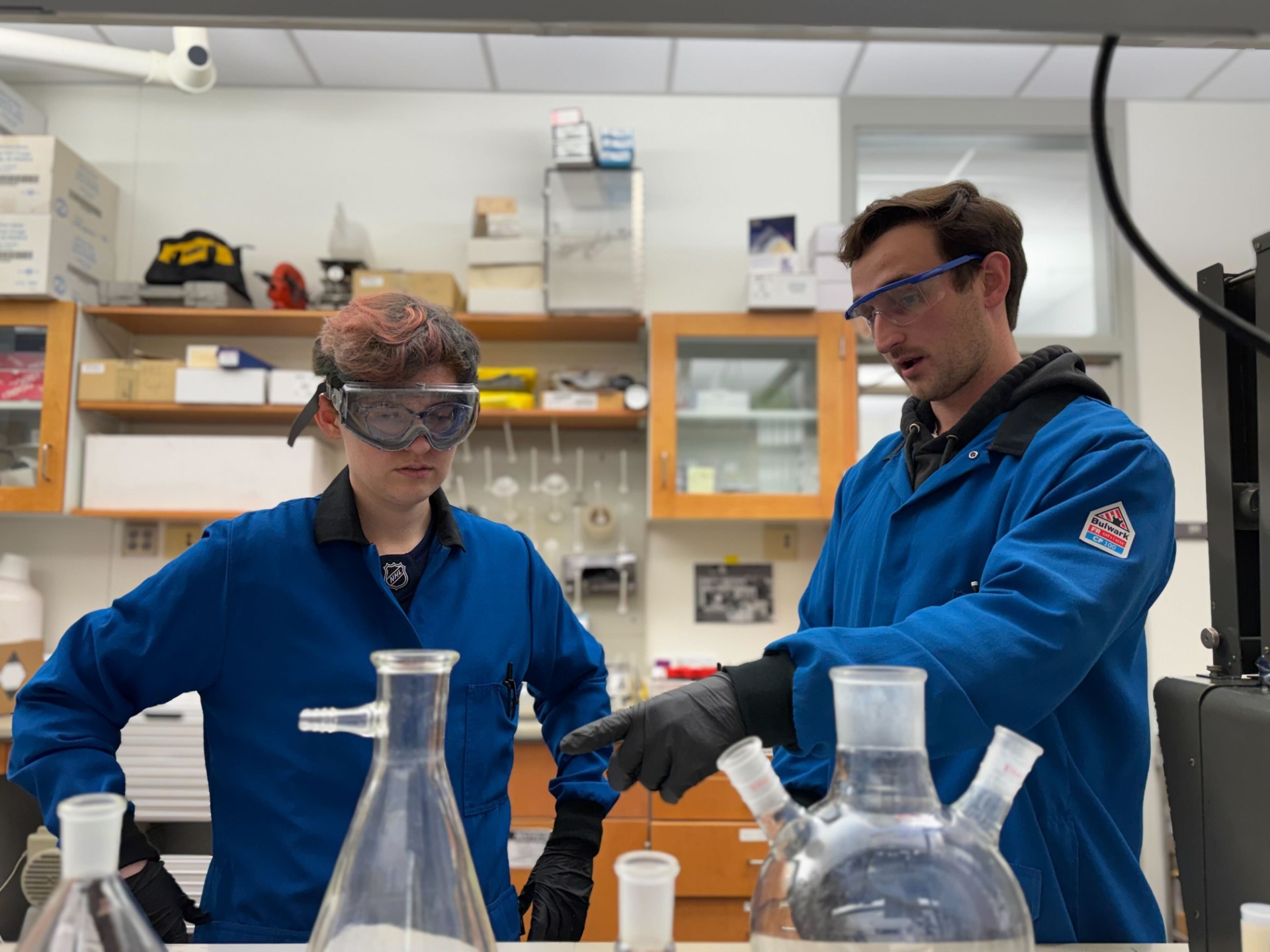
Chemistry Ph.D. students Bryn Werley, left, and Aidan Clarkson focused their study on a simple, widely available class of molecules called salicylaldehydes. Traditionally, chemists have avoided these molecules because they are difficult to control when trying to make only one 3D version of a compound. Instead of treating them as a limitation, the team asked whether salicylaldehydes could be used to set a molecule’s shape early on and then carry that information through later steps.
January 12, 2026 I By Dave DeFusco
Chemists often think of aromatic molecules, such as phenols, as very stable and hard to change. Their flat, ring-like shape makes them dependable ingredients, but also difficult to turn into more complex, three-dimensional molecules. In a study published in Chemical Science, researchers at UNC-Chapel Hill show how this stability can actually be overcome. By carefully adding to and reshaping these flat molecules, the team developed a flexible new way to build complex 3D structures with a defined left- or right-handed shape, an essential feature for many medicines and advanced materials.
The research was conducted in the lab of Jeffrey Johnson, the A. Ronald Gallant Distinguished Professor of Chemistry, with contributions from current Ph.D. students Aidan Clarkson and Bryn Werley, as well as former graduate students Kimberly Alley and Jacob Robins. The study focuses on a simple, widely available class of molecules called salicylaldehydes. Traditionally, chemists have avoided these molecules because they are difficult to control when trying to make only one 3D version of a compound. Instead of treating them as a limitation, the UNC team asked whether salicylaldehydes could be used to set a molecule’s shape early on and then carry that information through later steps.
“The idea grew out of earlier projects in the lab,” said Clarkson. “People were trying to build very complicated molecules and needed a reliable way to control their 3D shape. We realized we could start by setting that shape in one small part of the molecule and then transfer it as the molecule was reshaped.”

A key part of that reshaping process is something called dearomatization, which means taking a flat, stable molecule and using creative strategies to unlock its hidden functionality. The challenge is controlling the molecule’s handedness—two versions that are shaped the same but oriented differently in space—so that only one 3D form is made. Living systems are very sensitive to handedness. One “hand” of a molecule might work as a helpful medicine, while the other might be less effective or even harmful. That’s why controlling handedness is so important in making drugs and other advanced materials.
For decades, this has been difficult because most methods try to control shape and reshape the molecule at the same time, often making reactions unpredictable or limited. The UNC researchers took a different approach. First, they developed a new reaction that attaches a small phosphorus-containing piece to salicylaldehydes in a controlled, one-sided way. This type of reaction had never before been successfully applied to these molecules. By using a carefully designed copper-based catalyst, the team was able to create molecules with a well-defined 3D shape in a single, efficient step.
“Salicylaldehydes behave in an unusual way,” said Clarkson. “One part of the molecule can lose a small positive charge, which changes how the rest of the molecule reacts. That makes the chemistry tricky, because you’re trying to add something with extra electrons to a part of the molecule that already has extra electrons. The copper catalyst helps by holding the molecule in just the right position, so the reaction can happen in a controlled way.”
Once the molecule’s 3D shape was set, the researchers moved on to the next stage: uncovering the hidden functionality of the flat, ring-like structure so it could be used to form more complex architectures. Because this step was kept separate from the earlier shape-setting reaction, the team could choose different chemicals to guide the molecule down different paths. One option led to reactions that formed new rings with high precision, while another opened up alternative routes to different structures.
“Keeping these steps separate turned out to be critical,” said Werley. “In older approaches, controlling shape and reshaping the molecule usually happened at the same time, which limited flexibility. By splitting the process into two steps, we gained much more control over the final outcome.”
Exploring these different paths led to some surprises. In some cases, the newly installed phosphorus-containing handle completely blocked one face of the flat portion and guided the new rings to form on the open face of the flat portion of the molecule, just as the researchers expected. In others, attractive forces between different parts of the reacting molecules quietly determined the final shape.
“That kind of control really surprised us,” Werley said. “We didn’t design the system with those attractive forces in mind, but they turned out to be very powerful and have inspired new ideas for guiding other reactions.”
Along the way, the researchers encountered another common challenge: newly formed molecules tended to stick to each other instead of reacting as intended. Rather than trying to eliminate this behavior, the team found a way to work with it.
“By raising the temperature, we allowed those paired molecules to separate again,” said Clarkson. “That gave us a chance to guide them toward a more useful reaction and get the product we wanted.”
For Johnson, the broader impact lies in how the work expands the possibilities of chemical synthesis. “Turning flat molecules into complex ones is one of the most powerful things we can do,” he said. “By separating the step where we control shape from the step where we reshape the molecule, we gain a level of precision and flexibility that wasn’t available before.”